If you have ever waited weeks for a contractor only to have the job done poorly, or paid a premium for a company that seemed too busy to care, you already understand why speed and popularity are not the same as quality. Homeowners often assume that a service provider with a packed schedule must be the best choice, but a full calendar can just as easily signal disorganization as demand. Understanding what actually makes a service company reliable, and why efficient operations matter more than sheer volume of jobs, can save you money, time, and frustration. This article breaks down what to look for so you can make a smarter decision the next time you hire help for your home or property.
What Operational Efficiency Really Means
Operational efficiency simply describes how well a company uses its time, staff, and resources to complete work correctly the first time. It is not about how many trucks are on the road or how many jobs get scheduled in a day. Instead, it reflects whether a business has systems in place that prevent wasted materials, repeat visits, and miscommunication between the office and the technician at your door.
For homeowners, this distinction matters because inefficient companies often pass their internal problems on to customers in the form of delays, price surprises, or rework. A well run operation, on the other hand, tends to show up on time, quote accurately, and finish the job without a callback. Recognizing the difference between busy and efficient is the first step toward hiring smarter.
Why a Packed Schedule Does Not Equal Better Service

It is tempting to assume that a company booked out for weeks must be the best option in town, but volume alone does not guarantee quality. A high number of jobs can just as easily mean a company is understaffed, undertrained, or overwhelmed and cutting corners to keep up. This is especially true in industries where speed is prioritized over precision, such as a moving business juggling too many trucks on the same day with too few experienced hands.
When a company takes on more work than it can properly manage, the strain usually shows up in small but costly ways. Boxes get damaged, appointment windows slip, and customer communication becomes an afterthought. Before assuming busier is better, it helps to ask how a company actually manages its workload rather than just how many jobs it books.
- Ask how many jobs are scheduled per crew per day
- Find out whether the same team handles the job from start to finish
- Check if estimates are based on an in-person assessment or a quick phone guess
- Look for reviews mentioning delays, damage, or rescheduling
How to Spot Genuine Skill in Home Repair Professionals
When you are hiring for structural or exterior work, the difference between an efficient operation and a chaotic one becomes obvious fast. Skilled roofers will typically inspect the full scope of the job, explain material options clearly, and provide a written timeline before work begins. Companies that rush this process to book more appointments often miss underlying issues like poor ventilation or hidden water damage that surface later as expensive problems.
The same logic applies when comparing a small local roofing business to a larger regional company. Size is not the deciding factor, but process is. A well organized roofing business will document the job with photos, provide clear warranties, and follow a consistent inspection checklist regardless of how many other jobs are on the schedule that week.
- Request a written scope of work before any contract is signed
- Ask about warranty terms on both labor and materials
- Confirm whether permits are pulled when required
- Look for consistent, detailed photos in past project reviews
Comfort Systems and the Cost of Rushed Work
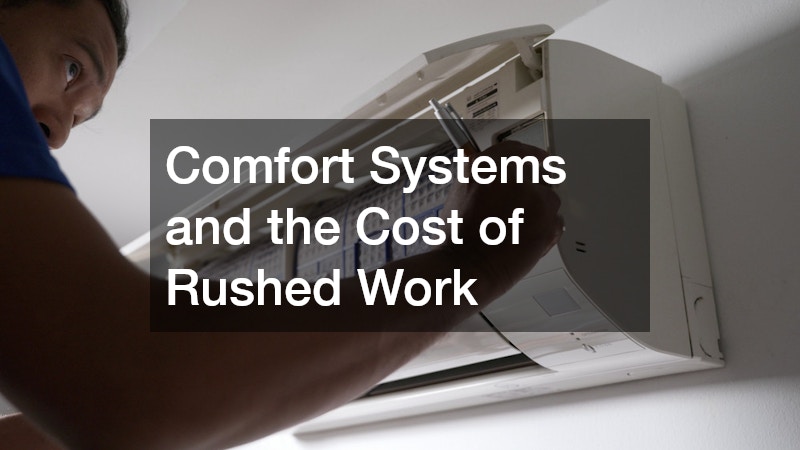
Heating and cooling systems are a good example of how efficiency directly affects your wallet. A rushed installation or repair from an overbooked hvac business can lead to improperly sized units, incorrect refrigerant charges, or ductwork that was never properly sealed. These mistakes are not always obvious right away, but they show up later as higher energy bills and premature equipment failure.
Consider sizing alone: an oversized unit can cost 15-20% more to run because it short-cycles instead of maintaining steady, efficient airflow, while an undersized one runs constantly and wears out years ahead of schedule. Refrigerant charge is just as unforgiving — being off by even a few ounces can reduce cooling efficiency by 5-10% and put unnecessary strain on the compressor, one of the most expensive components to replace.
Ductwork is often the least visible culprit. Leaky or poorly sealed ducts can waste 20-30% of the conditioned air a system produces, meaning customers pay to heat or cool space that never actually gets used.
For an hvac business trying to squeeze in one more job per day, these shortcuts might save an hour on-site. But the callbacks, warranty claims, and reputational damage that follow almost always cost more than the time saved — a pattern that reinforces why disciplined, unhurried work protects margins better than sheer volume ever could.
An efficient provider takes the time to calculate the correct system size for your home using a Manual J load calculation rather than relying on rule-of-thumb estimates or simply matching the old unit’s tonnage. They also test the work before leaving, checking refrigerant charge, static pressure, and airflow at the vents to confirm the system performs as designed. This upfront diligence often adds two to three hours to a typical installation but saves significant money over the life of the system.
The cost of skipping these steps shows up quickly. An oversized system short-cycles, wearing out components faster and leaving rooms with uneven temperatures, while an undersized system runs constantly and can inflate energy bills by 15 to 20 percent. Incorrect refrigerant charge alone can reduce a system’s efficiency by 10 percent or more and shorten its lifespan by several years.
When comparing quotes, it is worth asking how much time a technician plans to spend on testing and calibration, not just installation. A contractor who can’t describe their load-calculation method or mentions skipping airflow testing to save time is likely setting the customer up for a callback, a higher utility bill, or an early equipment replacement.
What Happens Below Ground Matters Just as Much
Some of the most important home systems are also the least visible, which makes efficiency even more critical when hiring for underground work. A drain cleaning business that relies on guesswork rather than camera inspection can miss the actual source of a clog, leading to repeat visits and continued damage. Efficient companies invest in diagnostic equipment so they can identify the real problem instead of applying a temporary fix.
The same principle applies to a septic pumping business, where thoroughness matters more than how quickly the truck can get in and out. A rushed pumping job can leave solids behind that shorten the life of your system and lead to costly backups down the road. Homeowners should ask whether inspection and pumping are done together, since skipping this step is often a sign of a company more focused on volume than results.
- Ask if camera inspections are included before major repairs
- Request documentation of tank size and pumping frequency recommendations
- Confirm whether technicians check for root intrusion or collapsed pipe sections
- Look for companies that explain findings in plain language, not just technical jargon
Why Well Maintained Tools Matter More Than a Big Fleet

It is easy to assume that a company with a large inventory of trucks and machines can handle any job faster, but equipment condition matters more than equipment quantity. An equipment rental business that keeps its machines well maintained and regularly serviced will cause fewer delays and safety issues than one that simply has more units sitting in a lot. Worn out equipment leads to breakdowns mid-project, which then delays your timeline regardless of how many other machines the company owns.
When researching a provider, it is reasonable to ask how often equipment is inspected and serviced, and whether operators are trained on the specific models being used. A company that prioritizes maintenance schedules over simply expanding its fleet is usually more reliable when your project timeline is on the line.
The Value of Specialized Training Over Generalist Crews
Some home services require a level of specialized knowledge that a generalist crew simply cannot match, no matter how efficient they claim to be. A chimney sweeping business, for example, should employ technicians trained specifically in creosote buildup, flue liner inspection, and fire code compliance rather than treating the job as routine cleaning. This specialized focus tends to produce more thorough safety checks and fewer missed warning signs.
The same holds true in a carpet cleaning business, where technicians need to understand different fiber types, stain chemistry, and drying times to avoid damaging flooring or leaving mold-friendly moisture behind. A crew that treats every carpet the same way, regardless of material, is optimizing for speed rather than results. Asking about technician certifications and training programs is a simple way to gauge whether a company values expertise over throughput.
- Ask what certifications technicians hold for their specific trade
- Find out how often staff receive continuing education or updated training
- Request references for jobs similar in scope to yours
- Check whether the company specializes or handles many unrelated services
Renovation Projects and the Hidden Cost of Cutting Corners

Home renovation work is another area where rushing to finish more projects can quietly reduce quality. A flooring business that prioritizes quick turnaround may skip proper subfloor moisture testing, which can lead to warping or buckling within a year or two of installation. A moisture reading even a few percentage points above the manufacturer’s threshold, often around 12 to 14 percent for wood subfloors, is enough to cause planks to cup or separate once seasonal humidity shifts.
The same shortcuts show up elsewhere in a rushed schedule: skipping acclimation time for materials, ignoring subfloor leveling tolerances, or reusing underlayment that should have been replaced. Each of these steps takes an hour or two but can prevent thousands of dollars in warranty claims and re-installation labor later.
Efficient companies build this testing into their process regardless of how full their schedule is, treating it as a fixed checkpoint rather than an optional extra. They understand that a callback not only costs materials and labor twice, but also consumes the crew time that could have gone toward a new paying job, making thoroughness the more profitable path in the long run.
Homeowners can protect themselves by asking specific questions about acclimation time for materials and subfloor preparation steps before installation begins. Hardwood flooring, for instance, typically needs 48 to 72 hours to acclimate to a room’s humidity and temperature before it’s installed—skip this step and boards can warp or gap within months.
Subfloor prep matters just as much. A rushed crew might skip moisture testing, leveling compounds, or proper fastening schedules, all of which affect whether tile cracks, laminate buckles, or vinyl planks separate at the seams.
A company confident in its process will walk you through these steps without hesitation, citing specific timelines, moisture thresholds, or manufacturer requirements. One focused purely on volume may brush past them, offer vague reassurances, or push to start installation ahead of schedule just to keep multiple job sites moving.
How to Research a Company Before You Hire
Once you understand what efficiency actually looks like, the research process becomes much more targeted. Instead of relying only on star ratings, look for detailed reviews that mention communication, accuracy of quotes, and whether the job was completed without follow-up visits. Patterns across multiple reviews tend to be more revealing than a single five star or one star post.
It also helps to talk directly with a company representative before booking and pay attention to how they answer your questions. Vague answers about scheduling, pricing, or process are often a sign of a business stretched too thin, while specific and confident answers usually indicate a company with solid internal systems.
- Read reviews for mentions of rescheduling or incomplete work
- Ask how the company handles unexpected problems during a job
- Request a clear breakdown of costs before signing anything
- Notice whether the company answers questions promptly and clearly
Choosing the right service provider comes down to looking past busy schedules and marketing claims to understand how a company actually operates day to day. Efficient businesses invest in training, maintenance, and clear communication because it protects their reputation and your property alike. The next time you are comparing quotes or reading reviews, focus less on who can start the soonest and more on who can explain their process with confidence. That single shift in how you evaluate a company can save you significant time, money, and stress down the road.